Dear Android developer,
Please let us introduce our new services that can make your app look more appealing and will eventually lead to more downloads.
1. Positive ratings
- Adding 100 5-star ratings and 10 positive comments to your Google Play page
Price: $135
- Adding 1.000 ratings with 100 comments
Price: $9502. Facebook likes
- Adding 25.000 Facebook likes to your Facebook page
Price: $250- Adding 100.000 Facebook likes
Price: $750

oneblogsleft will cover game design/development, coding, games & computers in general, and anything else onelivesleft related too verbose to be covered by a tweet
Monday, 9 September 2013
In case you were wondering what a 5-star rating is worth...
Just received this email:
Progenitor - Tempo: In Play
 |
![+1, 0ER, [starting deck is made of these]](http://www.onelivesleft.com/cardgame/cards/Charge.png "Charge") |
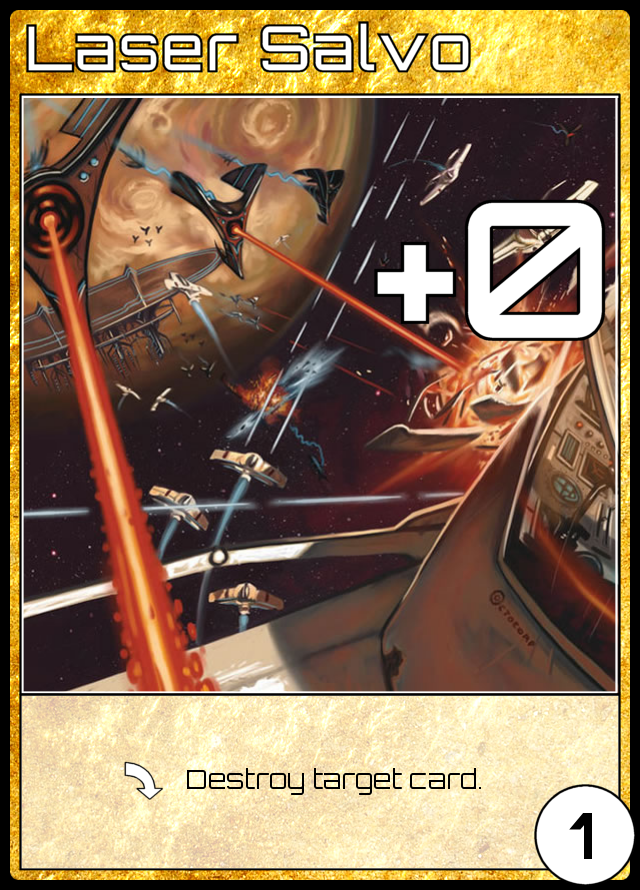
Let's say you play a Laser Salvo (1ER, +0, played: destroy target card). If you destroy an opponent's Charge (0ER, +1, [starting deck is made of these]), what have they lost? They have lost 1 Energy. Ignore that they had to draw and play the Charge; that is irrelevant. The direct change to the state of the game is that they now have 1 less Energy than they did before. You might think that your play was therefor worth 1 tempo, and it would be, except that them losing 1 Energy is not the only change in the state of the game: you now have 1 less card in hand than you did before.
Therefor, your play was worth 0 tempo: you have set them back by a point (of Energy) at the expense of a point of your own (a card in hand; a draw).
Scoring your tempo is an interesting idea: obviously, the more tempo you gain the better, so you would want this to be high. If it were a computer game (or you were particularly bloody minded) you might be able to derive stats after the game was over, like your average tempo per turn. While it is clearly a good rule of thumb that the bigger-the-better for tempo/turn, during play it won't actually be key that this number is bigger than some goalpost figure: rather, it is important simply that it be bigger than your opponents'. Note that in a heads-up, 1v1 game the tempo score is zero-sum: any time you gain tempo your opponent loses it, and vice-versa; it's only in a multiplayer game that having a goalpost is possible; I'll look at tempo in multiplayer in a later post. Let's look at 1v1 now, as it's much simpler. In 1v1 tempo can be looked at as a peg moving up and down a number line:
Thursday, 5 September 2013
Progenitor - Tempo: Take Two
As discussed in the previous post, tempo is calculated by adding up your gain and your opponent's loss from a card effect when you play it. I stated that Laser Salvo (1ER, +0, played: destroy target card) is worth 2 tempo: when it destroys an opponent's card it costs them 1 draw and 1 play. However, in order to generate that destroy effect it has cost you 2 tempo as well: you have had to draw the Laser Salvo and then play it. Thus it could be argued that Laser Salvo is worth 0 tempo: -2 tempo from your draw & play, +2 tempo for opponents loss. If you imagine a play situation: opponent plays a Charge, then you destroy it with Laser Salvo. The game has moved on 0 tempo from your previous turn.
Theoretically you can calculate tempo in either of these ways: as the total produced by the cards effect, or that total - 2 (for your draw and play); as long as you do it consistently it would still work, since you are only comparing these numbers with each other. However, it is generally better to use the former, especially when we go on to use tempo to analyse actual plays:
Theoretically you can calculate tempo in either of these ways: as the total produced by the cards effect, or that total - 2 (for your draw and play); as long as you do it consistently it would still work, since you are only comparing these numbers with each other. However, it is generally better to use the former, especially when we go on to use tempo to analyse actual plays:
Saturday, 31 August 2013
Progenitor - Tempo
Tempo is an analysis tool I first encountered applied to Magic: The Gathering. It's a means to quantify the potency of a given card or play, a way to attach a number so that different cards/plays can be compared.
In M:TG you have several resources available to you. Primarily you have your hand of cards and the mana you can generate in your turn. As well as that you have your deck of cards, and your life total and your graveyard. These different resources could be tied together using tempo. A unit of tempo is a measure of making progress in the game: you could gain tempo by either causing a gain on your part, or making your opponent lose something. In M:TG this worked out to being 1 Card = 4 Life = 4 Mana. So if you were playing, and had a chance to draw a card by paying three or less mana, then that would generally be a good deal. Attaching a value to a turn in M:TG is hard as you can do so many things in a turn.
In Progenitor we have it much easier:
In M:TG you have several resources available to you. Primarily you have your hand of cards and the mana you can generate in your turn. As well as that you have your deck of cards, and your life total and your graveyard. These different resources could be tied together using tempo. A unit of tempo is a measure of making progress in the game: you could gain tempo by either causing a gain on your part, or making your opponent lose something. In M:TG this worked out to being 1 Card = 4 Life = 4 Mana. So if you were playing, and had a chance to draw a card by paying three or less mana, then that would generally be a good deal. Attaching a value to a turn in M:TG is hard as you can do so many things in a turn.
In Progenitor we have it much easier:
Monday, 12 August 2013
Progenitor - Synopsis
As outlined in my previous post, Progenitor is a deck-building card game. This post will be a simple primer on it, so that when I write about design and balance decisions people will know what I'm talking about.
The basics are quite simple: in any given game there will be a several different stacks of cards in the middle of the table. You will be trying to acquire these cards, to add them to your deck in order to improve it and allow you to win.
The resource used is called Energy: each of the available cards has an Energy Requirement which must be met in order to prime (read: buy) it from the table and add to your deck. At the start of the game your deck is made up of a few copies of the most basic card in the game: a simple +1 Energy card with no other ability. Energy Requirements for the cards on the table range from 1 to 3, with more expensive cards being more powerful.
On any given turn you may do one of three things:
The basics are quite simple: in any given game there will be a several different stacks of cards in the middle of the table. You will be trying to acquire these cards, to add them to your deck in order to improve it and allow you to win.
The resource used is called Energy: each of the available cards has an Energy Requirement which must be met in order to prime (read: buy) it from the table and add to your deck. At the start of the game your deck is made up of a few copies of the most basic card in the game: a simple +1 Energy card with no other ability. Energy Requirements for the cards on the table range from 1 to 3, with more expensive cards being more powerful.
On any given turn you may do one of three things:
Friday, 9 August 2013
Progenitor - Deck-Building Card Game
Alternate title: Progenitor - What I've Been Doing Instead Of Coding.
I've spent a lot of time playing CCGs. A lot. From the original Star Wars game (Decipher), through Legend Of The Five Rings (AEG), to the industry mainstay that is Magic: The Gathering (Wizards Of The Coast), these games have* a big draw on me. The (fairly) recent genre of deck-building games, kick-started by Dominion, draw on a portion of what makes those games so great, and so I had a go of them too.
What I found was that there was some good stuff to be found in them, great stuff in fact, but there were also qualities I really disliked. Primarily two:
Wednesday, 7 August 2013
Pigment & The Droid, Part 3
As foreshadowed at the end of Part 2, the optimisations described therein were not enough to get Pigment to run on the Motorola Droid. Pigment was still using too much memory for the Droid to handle.
So: to get Pigment to run on a Droid it needed to use less heap. How to accomplish this? It needed to hold less graphical data. I'd already reduced image memory size as much as possible regarding format and storage options (such as removing the alpha channel); I either had to load less of the assets, or generate less content as the game ran. In the end I did both!
The first saving relies on how the user experiences the game; as they play and complete levels the game will send messages to them: the Win! message, the tip about pressing Back to undo, the Bonus Unlocked messages, the Congratulations on completing worlds / the game. Of these: the Science Unlocked message and the final Congratulations message on completing the game made a useful pair.
So: to get Pigment to run on a Droid it needed to use less heap. How to accomplish this? It needed to hold less graphical data. I'd already reduced image memory size as much as possible regarding format and storage options (such as removing the alpha channel); I either had to load less of the assets, or generate less content as the game ran. In the end I did both!
The first saving relies on how the user experiences the game; as they play and complete levels the game will send messages to them: the Win! message, the tip about pressing Back to undo, the Bonus Unlocked messages, the Congratulations on completing worlds / the game. Of these: the Science Unlocked message and the final Congratulations message on completing the game made a useful pair.
Subscribe to:
Posts (Atom)